
In my previous journal entry, I wrote about how we at OKURADO came to receive the commission for our first-ever jewelry piece: the collaboration jewelry with the twelfth-generation Kabuki actor Ichikawa Danjūrō.
I was deeply moved that the newly established OKURADO had been entrusted with creating such an important gift for Prince Albert of Monaco. I felt strongly that we must create jewelry of “distinctive elegance and uniqueness” to repay this kindness, no matter what.
The idea for the “MIMASU”jewelry immediately came to mind.
The piece would be a pin brooch adorning Prince Albert’s chest. Using OKURADO ‘s unique techniques, a maki-e artist would apply “Danjuro Brown” lacquer in the shape of a “MIMASU” on 18-karat gold, with diamonds delicately set in a fine line around it. A majestic“MIMASU” jewelry piece, crafted with the delicate techniques of Japanese artisans, worthy of the prestigious Ichikawa Kabuki family.
I intuitively decided on this design, knowing instantly it was the only choice.
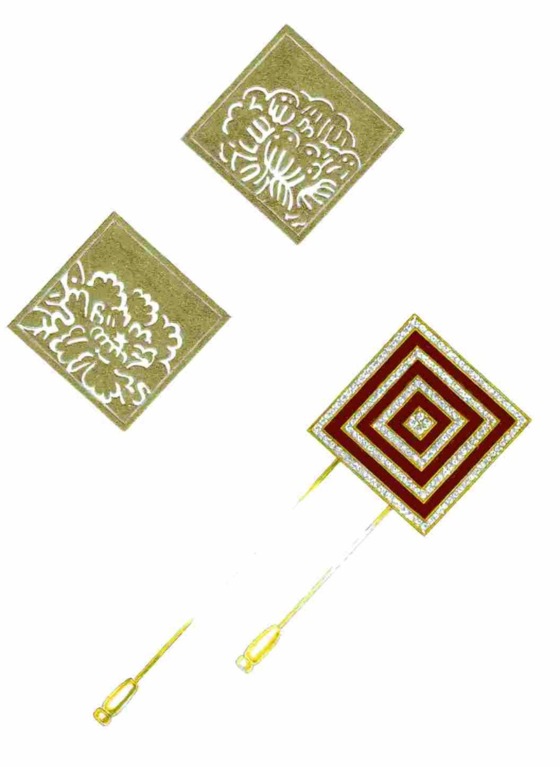
design sketch
I commissioned the work to a veteran craftsman who has been working for my father since his generation. When I explained the request, the design, and the story of the person who would ultimately wear it, the craftsman silently nodded and finally replied to me with just one word: “Understood.”
From our long association, I knew well that this single word, “Understood,” meant the artisan already had the three-dimensional form fully formed in his mind and would create something surpassing the design drawings. I placed my complete trust in this artisan to realize the form.
In fact, this artisan was a huge fan of Kabuki. The very next day, he brought numerous Kabuki books from his home to his workshop. He studied the motif of the“MIMASU” (a traditional measure of volume), and created a prototype: a delicate yet powerful form crafted from 18-karat gold, diamonds, and lacquer. Furthermore, he meticulously recreated the “peony” sketch drawn by Mr. Danjūrō himself as an openwork pattern on the back of the pin brooch, using a jigsaw.
From the very act of creation, I sensed a passion that transcended mere jewelry making—a desire to express Japan’s traditional beauty through our craftsmanship and present it to the Prince of Monaco.
I took the prototype to consult with a maki-e artist in Echizen about the lacquer. This maki-e artist and I have worked together for several years. He was the one who, through trial and error, helped realize my desire to create jewelry by applying lacquer directly onto precious metals and combining it with diamonds. I explained the details of this new request along with the prototype and asked him to apply lacquer in the “Danjuro Brown” color requested by Mr. Danjuro.
However, there was a problem. The color of this “Danjuro Brown” popular during the Edo period, had no clear definition despite my research. I inquired with the Ichikawa family, but they said no color samples existed. When I relayed this, the lacquer artist simply said, “Understood,” then fetched several kabuki books from the back room of his workshop and began researching.
(Fortunately, the artisans around me are all men of few words, but they never compromise and deliver perfect work.)
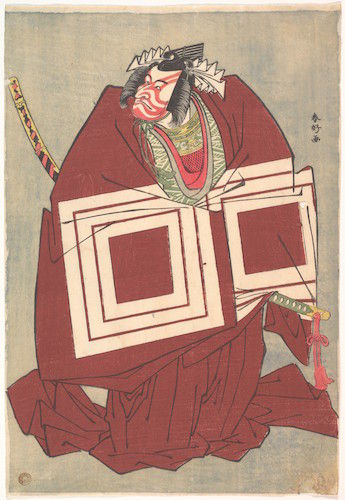
“Danjuro Brown”
quated from https://colortest.jimdoweb.com/
A few days after returning to Tokyo, the lacquer artist contacted me. He said he believed this color was likely the “Danjuro Brown” shade, that he could reproduce it in lacquer, and asked me to come see it. I immediately traveled to Echizen and examined the reference materials he showed me. The color depicted there was precisely the “Danjuro Brown” I had envisioned. It also harmonized beautifully with the 18-karat gold, so I decided to apply this “Danjuro Brown” lacquer to the lacquered sections.
The craftsmen at OKURADO, the maki-e artists, and I myself were driven by a shared desire that transcended the scope of our work: to recreate traditional Japanese designs and colors, to give them form, and to present them to members of overseas royal families. It was a moment that deeply impressed upon me how everyone truly cherished Japanese culture, and a moment I felt proud to have been born in a country with such unique traditional culture.
However, once we actually began production, the path to completion proved to be extremely difficult.
I’ll leave it here for now and continue the story in the next journal.
Hitoshi Okura
OKURADO
Part 1,3 please also read this ▼
OKURADO: The Beginning of Jewelry, Part 1
New Entry
RELATED POST
-
-

-
2024.09.25
CATEGORY:highjewelry creation
Jewelry that brings out the full appeal of gemstones (diamonds)
-
-
-

-
2024.10.25
CATEGORY:highjewelry creation
Flow of Custom-made Jewelry Acceptance
-
-
-

-
2024.04.04
CATEGORY:highjewelry creation
Diamonds and Conflicts
-
-
-

-
2023.02.20
CATEGORY:highjewelry creation
「より強く輝く」ダイヤモンドとは
-
RESERVE
OKURADO SALON, located in the corner of Shiba-Koen Park near Tokyo Tower, offers you an experience to enjoy the intricate beauty of OKURADO’s fine jewelry and to observe the elaborate work of their artisans.
Visits to the salon are by appointment only.
To make an appointment, please feel free to contact us using the form below or by phone.
Hours of operation:11:00-19:00
Holidays:Sundays, National Holidays,
Summer/Winter holidays